
How RFID Cloud Works: A Step-by-Step Guide to Real-Time Asset Tracking
What Is RFID Cloud?
RFID Cloud is a cloud-based platform that connects RFID hardware — tags, readers, and antennas — to a centralized dashboard for real-time asset tracking. Unlike traditional on-premise RFID systems that require dedicated servers and complex IT infrastructure, RFID Cloud runs entirely in the cloud, making deployment faster, more scalable, and significantly more cost-effective.
Whether you are tracking inventory in a warehouse, monitoring equipment in a hospital, or managing tools across construction sites, RFID Cloud gives you full visibility into where your assets are — in real time.
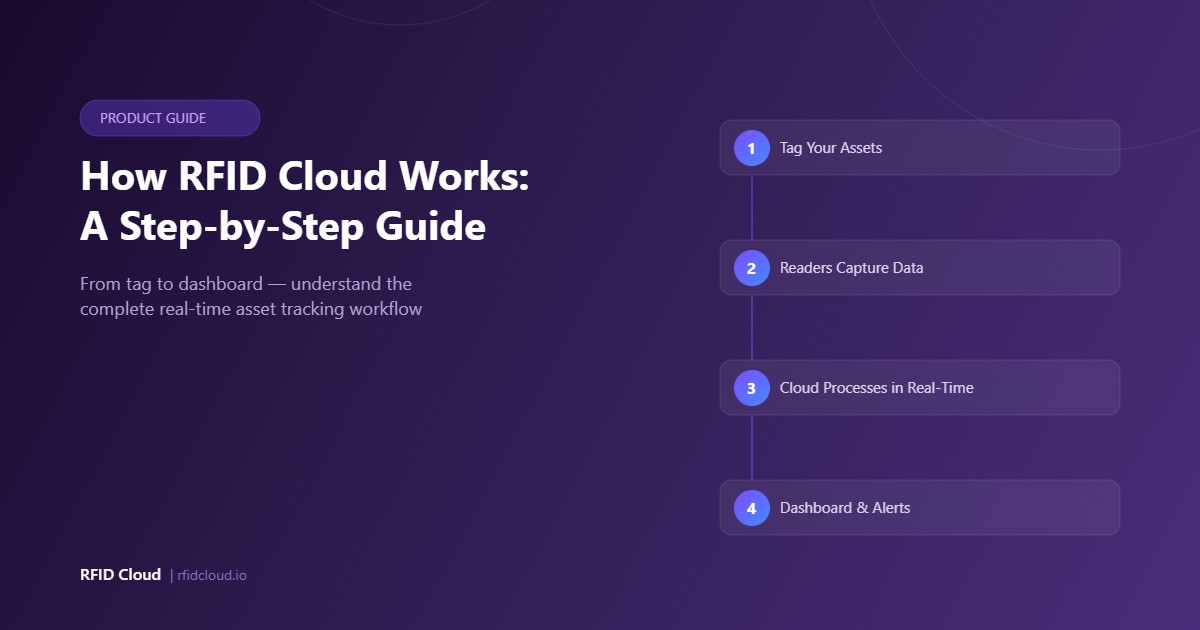
Step 1: Tag Your Assets
The process begins with attaching RFID tags to the items you want to track. RFID tags are small, durable devices that store a unique identifier. They come in various form factors — adhesive labels, hard tags, wristbands, or embedded chips — depending on the use case.
Each tag is linked to an asset record in the RFID Cloud platform. This means every physical item gets a digital identity that the system can recognize and monitor automatically.
Step 2: RFID Readers Capture Data
Once your assets are tagged, RFID readers installed at key locations — doorways, shelves, loading docks, or checkpoints — continuously scan for nearby tags. These readers use radio waves to detect tags within their range, capturing data such as tag ID, timestamp, and reader location.
RFID Cloud supports a wide range of readers from leading manufacturers, making it easy to integrate with existing hardware or set up new installations.
Step 3: Data Flows to the Cloud in Real Time
As readers capture tag data, it is transmitted instantly to the RFID Cloud platform via secure internet connections. The cloud processes this data in real time, updating asset locations, triggering rules, and logging movement history.
Because everything runs in the cloud, there is no need for local servers or complex networking. Data is encrypted in transit and at rest, ensuring enterprise-grade security without the enterprise-grade IT overhead.
Step 4: Dashboard Insights and Alerts
The RFID Cloud dashboard is where the magic happens. From a single interface, you can see where every tagged asset is located, view movement history, and set up automated alerts. Key features include:
Real-time location maps showing asset positions across your facility. Movement history logs for audit trails and compliance. Geofencing and zone alerts that notify you when assets enter or leave designated areas. Custom reports for inventory counts, utilization rates, and shrinkage analysis.
The dashboard is accessible from any device with a web browser — desktop, tablet, or mobile — so you can monitor your assets from anywhere.
Step 5: Integrate with Your Existing Systems
RFID Cloud is designed to work alongside your existing business tools. Through REST APIs and pre-built integrations, you can connect RFID Cloud to your ERP, WMS, CMMS, or other enterprise systems. This means asset tracking data flows directly into the tools your team already uses, eliminating manual data entry and reducing errors.
Why Cloud-Based RFID Matters
Traditional RFID systems often require significant upfront investment in servers, software licenses, and IT expertise. RFID Cloud eliminates these barriers by delivering everything as a service. Benefits include faster deployment measured in days rather than months, lower total cost of ownership with no servers to maintain, automatic updates and new features delivered seamlessly, and the ability to scale from a single location to hundreds without infrastructure changes.
Getting Started with RFID Cloud
Ready to see how RFID Cloud can transform your asset tracking? Getting started is simple. Contact our team for a free consultation and demo. We will help you identify the right tags and readers for your environment, configure your dashboard, and have you up and running quickly.
Contact us today to schedule your personalized demo and discover how real-time asset visibility can improve your operations.